CFG Training Experiences for Canadian Youth Football Players
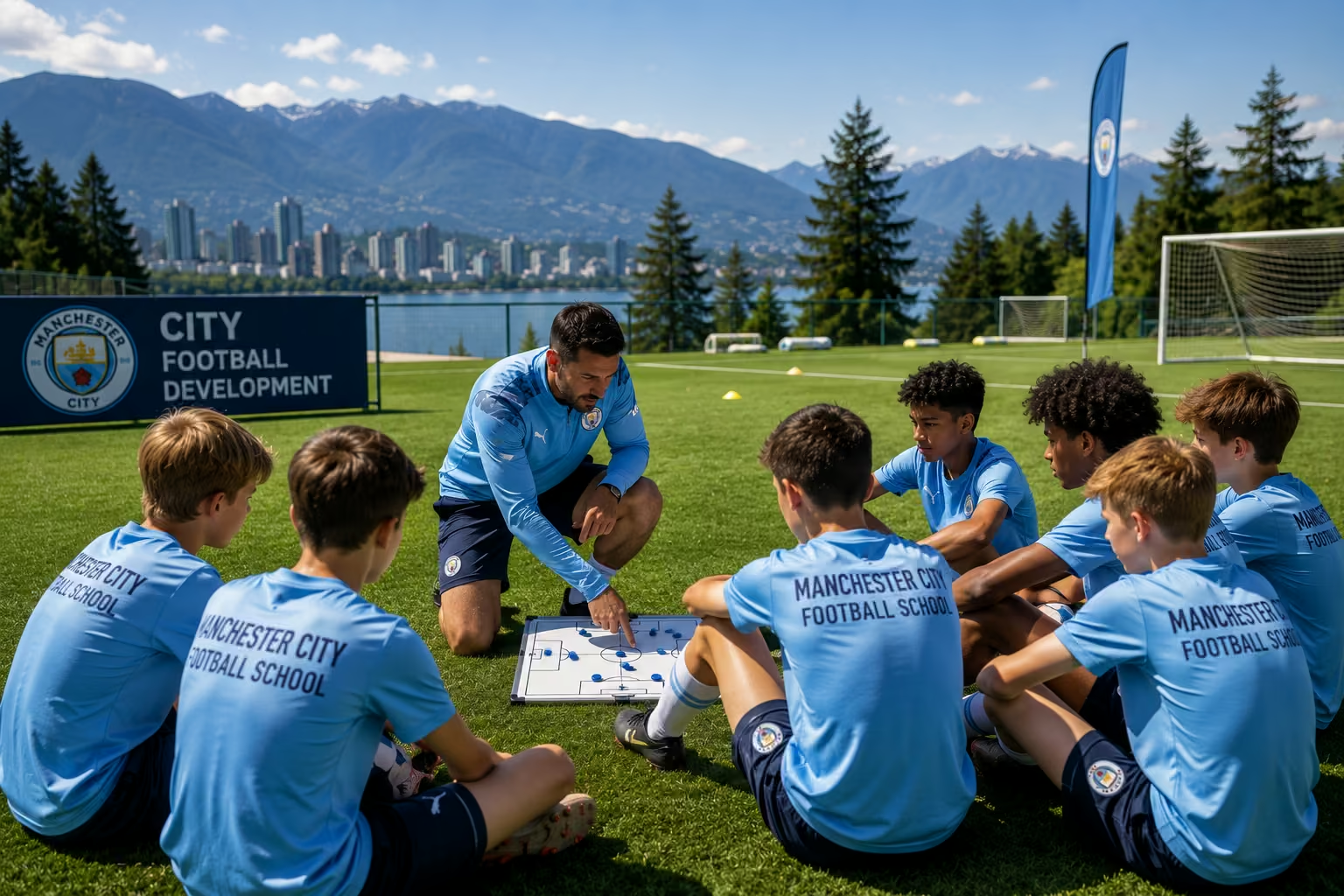
Manchester City Football Camps in Canada give young players a structured opportunity to experience training connected to one of the most recognized football development environments in the world. For parents, players, coaches, and academy directors, the main question is practical: what should a player expect when attending a CFG training program through Match Tour 11?
The answer should be clear and realistic. These camps are designed to provide professional football training exposure, City methodology, and a demanding but constructive player development environment. They are not a guaranteed trial, a professional contract pathway, or a shortcut into an academy system.
Through Match Tour 11’s exclusive City Football Group partnership for Canada, Canadian players can access official Manchester City Football School programming delivered under the Manchester City Football School brand. Current British Columbia camp locations include West Vancouver, Kelowna, and Richmond.
For many families, this is a practical first step into a higher-standard football learning environment without needing to travel overseas. Players can train closer to home while experiencing coaching ideas, session standards, and development principles connected to Manchester City’s football methodology.
What Are Manchester City Football Camps in Canada?
Manchester City Football Camps in Canada are official training camp opportunities delivered through Match Tour 11’s Canadian City Football Group partnership. They are built around the Manchester City Football School model and designed to expose Canadian players to a professional football development environment.
The camps focus on player learning. That may include technical execution, tactical awareness, decision-making, movement, communication, defensive habits, attacking principles, and confidence in game-like situations. The exact structure can vary by age group, location, schedule, and camp format, but the core purpose remains development.
Parents should understand the distinction between a camp and a trial. A camp is a training and development experience. A trial is a formal evaluation inside a club environment. A pathway is the wider process that may include camps, team tours, individual evaluations, player trials, and long-term management support when appropriate.
Manchester City Football Camps in Canada should therefore be seen as a high-quality football education experience. They can help a player improve, understand higher expectations, and benchmark their habits against a more professional reference point.
Why Match Tour 11 Delivers This Program in Canada
Match Tour 11 is an international football agency and sports tourism brand founded in 2018 and based in North Vancouver, British Columbia. The company operates across North America and Europe, supporting players, teams, academies, clubs, and school football programs through football tours, training camps, player trials, player evaluations, player management, and professional signing support.
As the exclusive City Football Group partner for Canada, Match Tour 11 provides Canadian access to the CFG network, including Manchester City and Girona FC. That partnership is central to how Manchester City Football Camps in Canada are made available to Canadian players.
This matters because Canadian families need a credible local access point. Rather than trying to interpret overseas opportunities alone, players and parents can work through a Canadian-based football organization that understands both the domestic player environment and the international football pathway conversation.
Match Tour 11’s role is not only to promote a camp. Its broader football service model allows players and families to understand how camps may connect to future training, international football tours, individual evaluations, trials, or player management where appropriate.
1. Players Can Expect a Professional Training Environment
The first thing players should expect from Manchester City Football Camps in Canada is a more professional training environment than a casual holiday camp. The sessions are intended to be purposeful, organized, and development-focused.
Players should arrive ready to work. That means listening carefully, being punctual, bringing the right equipment, managing energy, responding to feedback, and competing with focus. Coaches will be looking for more than technical ability. They will also notice attitude, concentration, coachability, communication, and how a player responds when challenged.
A professional training environment does not mean every player must already be elite. It means the standard of behaviour and learning should be serious. Players who are open-minded, disciplined, and willing to improve often benefit most from this type of camp.
Parents should prepare players for that expectation before the first session. The camp is not just about attending a recognizable football brand. The real value comes from engaging with the training, applying coaching points, and taking lessons back into the player’s regular club or academy environment.
2. Players Can Expect City Methodology and Development Principles
Manchester City Football Camps in Canada are built around the City methodology. That means players can expect coaching ideas connected to how Manchester City approaches football education and player development.
In practical terms, players may work on technical quality, intelligent decision-making, positional understanding, attacking and defending principles, small-sided games, movement off the ball, and confidence in 1v1 situations. These details matter because modern football rewards players who can think quickly, execute cleanly, and adapt to changing game situations.
For younger players, small-sided formats can be especially useful because they increase touches, decisions, pressure, and involvement. For older or more advanced players, the emphasis may shift toward sharper execution, tactical detail, physical intensity, and the ability to solve more complex football problems.
The City methodology should not be treated as a magic formula. A player does not transform in one camp. The value is exposure to better habits, clearer standards, and coaching details that can support long-term development if the player continues applying them after the camp.
3. Parents Can Expect a Development-First Experience
Parents often want to know whether Manchester City Football Camps in Canada are about development, scouting, or future opportunity. The correct expectation is development first.
A good training camp helps players understand where they are now and what they need to improve. It can challenge a player technically, tactically, mentally, and socially. It can also give parents a more objective reference point by exposing the player to a different coaching environment.
Parents should avoid viewing the camp as a guaranteed pathway to professional football. That mindset can create unnecessary pressure and unrealistic expectations. Instead, the better question is whether the player can learn from the environment and return to regular training with stronger habits.
For example, a player may learn that they need to scan more before receiving the ball. Another may realize that they must communicate earlier. A forward may be challenged to improve pressing triggers. A defender may need to work on body shape and decision-making under pressure. These are useful development outcomes even if they are not dramatic.
Manchester City Football Camps in Canada are most valuable when families treat them as part of the player’s development process, not as a one-week judgment of the player’s future.
4. Players Can Expect Technical and Tactical Detail
Players attending Manchester City Football Camps in Canada should expect coaching detail. This may include both individual technical points and broader tactical ideas.
Technical work may include receiving, passing, dribbling, finishing, defending, turning, body position, ball manipulation, and first touch. Tactical work may include creating space, supporting angles, defensive compactness, pressing, transition moments, playing forward, and understanding roles within a team structure.
The key is that technical actions are usually connected to football decisions. A player may not only be asked to pass accurately. They may be asked to pass at the right time, into the right space, with the correct weight, while understanding what the next action should be.
This is an important difference for Canadian players. Many players can perform isolated technical actions, but the game demands those actions under pressure. A CFG training program should help players connect technique with decision-making.
Parents watching from the outside should not judge the camp only by whether players look busy. High-quality training is not always about constant running. Sometimes the most valuable coaching moments come through correction, questioning, guided repetition, and game-based learning.
5. Families Can Expect Practical Canadian Access Points
One of the main advantages of Manchester City Football Camps in Canada is access. Players do not need to begin with overseas travel to experience Manchester City Football School programming.
Match Tour 11 currently supports camp delivery in British Columbia, with locations including West Vancouver, Kelowna, and Richmond. These locations give families in Metro Vancouver, the North Shore, the Interior, and surrounding regions a more practical way to participate.
The right location depends on the family’s schedule, travel needs, and the player’s readiness. A player should arrive prepared, rested, hydrated, and able to focus. If travel becomes too demanding, it can affect the quality of the camp experience.
Families should also consider the player’s age, maturity, and current training load. A camp can be demanding. Players who arrive after a heavy competition schedule, poor sleep, or insufficient recovery may struggle to get the full value from the program.
To review current camp dates, location details, registration requirements, and age-group availability, families should visit Match Tour 11’s training camps page or contact Match Tour 11 directly.
6. Players Can Expect to Be Challenged Beyond Their Comfort Zone
Manchester City Football Camps in Canada should challenge players. That challenge may come from the pace of the session, the detail of the coaching, the quality of other players, or the expectation to think more clearly during game situations.
For some players, the challenge will be technical. They may need a better first touch, quicker feet, or more consistent passing. For others, the challenge will be tactical. They may need to scan earlier, move into better spaces, or understand when to press and when to hold position.
For many players, the challenge is mental. They need to stay focused after mistakes, accept correction, compete without frustration, and continue working when the session becomes difficult.
This is a positive part of the experience. Development requires discomfort. A player who is never challenged may not understand what needs to improve. A player who is challenged in the right environment can leave with clearer goals and stronger motivation.
Parents should support this process carefully. The most useful post-camp conversation is not “Were you the best player?” It is “What did you learn, what was difficult, and what will you work on next?”
7. Families Can Expect Honest Pathway Context
Manchester City Football Camps in Canada can fit into a larger player pathway, but they should be placed in the right context. A camp is not a professional contract, academy trial, or selection guarantee.
For players who show strong ability, maturity, and long-term potential, a camp may help families understand what further development steps could make sense. Those steps might include more training, future camps, international football tours, individual evaluation opportunities, or a more structured player pathway conversation.
Match Tour 11 also provides player trials and evaluations for suitable players. These opportunities are separate from a camp and depend on the player’s level, readiness, profile, club fit, and availability. For players ready to compete professionally, Match Tour 11 also offers player management and professional signings.
This broader context is useful because families often need guidance. Not every player needs a trial. Not every strong youth player is ready for Europe. Not every development opportunity should be treated as a scouting event. A credible pathway should be realistic, staged, and based on the player’s actual level.
Manchester City Football Camps in Canada can be one valuable step inside that wider pathway, especially when the player uses the experience to improve after the camp ends.
What Should Players Bring to a CFG Training Program?
Players should arrive prepared for a serious training environment. Exact requirements may vary by camp, but the basic preparation should be consistent.
Player preparation checklist
- Proper football boots for the playing surface.
- Shin guards and appropriate training gear.
- Water bottle and hydration plan.
- Weather-appropriate layers for outdoor sessions.
- Nutritious snacks or meals if required by the schedule.
- Any required registration, waiver, or medical information.
- A focused attitude and willingness to receive feedback.
- A notebook or simple post-session reflection habit if the player wants to track learning points.
Parents should confirm specific equipment and schedule details with Match Tour 11 before the camp. The goal is to remove avoidable stress so the player can focus fully on training.
How Should Players Prepare Before Camp?
Players should prepare physically, technically, and mentally before attending Manchester City Football Camps in Canada. The goal is not to overtrain before camp. The goal is to arrive sharp, healthy, and ready to learn.
In the week before camp, players should prioritize sleep, hydration, light technical touches, mobility, and normal training rhythm. Heavy extra workouts immediately before camp are usually not helpful. Fatigue can reduce learning quality and increase injury risk.
Technically, players can prepare by working on first touch, passing with both feet, receiving across the body, dribbling changes of direction, and scanning before receiving. These habits appear constantly in high-quality football environments.
Mentally, players should prepare to listen. They should expect correction. They should understand that mistakes are part of learning. The best players are often not the ones who avoid mistakes, but the ones who respond intelligently when mistakes happen.
What Should Parents Watch For During Camp?
Parents should watch for learning behaviours, not only highlight moments. A player scoring goals or winning duels can be positive, but development is broader than visible output.
Useful signs include whether the player listens carefully, applies coaching points, communicates with teammates, stays engaged between actions, responds well to mistakes, and shows improvement across the camp.
Parents should also pay attention to the type of feedback the player receives. A correction is not a negative sign. In a strong training environment, coaches correct players because they are trying to improve details. The player’s response to correction is often more important than the correction itself.
After each day, parents can ask simple questions. What did the coach emphasize? What felt different from regular training? What was difficult? What did the player do better by the end of the session? These questions help turn the camp into a learning process rather than just an activity.
How Can Coaches and Academies Use These Camps?
Manchester City Football Camps in Canada are also relevant for coaches and academy directors. They can provide selected players with exposure to a recognized football methodology and help reinforce professional training behaviours.
An academy may encourage players to attend individually, or it may use camps as part of a broader development calendar. For example, a club could send players to a Manchester City Football School camp in British Columbia, then later organize international football tours or international tournaments through Match Tour 11.
This staged approach can work well. Players first experience methodology and training standards locally. Later, they may experience European football environments through team travel, training camps, matches, or individual evaluations.
The important point is continuity. A camp has more value when coaches help players apply the lessons afterward. Academy staff can ask players what they learned, integrate relevant themes into weekly training, and use the experience to support player development reviews.
How Is a CFG Training Program Different From a Regular Camp?
A CFG training program is different from a regular camp because it is connected to City Football Group methodology and the Manchester City Football School brand. The sessions are built around football development principles rather than generic activity programming.
A regular football camp may still be useful. It may provide touches on the ball, social development, fitness, and enjoyment. The difference with Manchester City Football Camps in Canada is the reference point. Players are exposed to a professional club methodology and a more specific development language.
This can be especially valuable for Canadian players who want to understand international standards. The camp can show them that football development is not only about effort or talent. It is also about detail, decision-making, repeatable habits, and the ability to apply coaching points under pressure.
That said, the camp is only one part of development. Players still need consistent weekly training, competitive matches, recovery, good coaching, and long-term commitment in their regular environment.
Useful Football Development Resources for Parents and Coaches
Parents and coaches can better understand the broader development environment by reviewing credible football education resources. Manchester City provides information about Learn Football for players and City Football Schools young player development. City Football Group also explains its wider academy development environments.
For broader football learning, the FIFA Training Centre offers development content for players and coaches. UEFA provides resources on coach development, coaching courses, and grassroots football programmes. Canadian families can also review the Canada Soccer ecosystem to understand the domestic player development landscape.
These resources help families evaluate Manchester City Football Camps in Canada with the right mindset. The camp should be viewed as a serious development opportunity, not as a guaranteed outcome.
Common Questions About Manchester City Football Camps in Canada
Are these camps official Manchester City Football School programs?
Through Match Tour 11’s exclusive City Football Group partnership for Canada, Canadian players can access official Manchester City Football School programming delivered under the Manchester City Football School brand.
Do players need to be elite to attend?
Players should be committed, coachable, and physically ready for age-appropriate football training. The best fit depends on the camp structure, age group, and player level.
Do the camps guarantee trials or academy selection?
No. Manchester City Football Camps in Canada do not guarantee trials, academy selection, scouting outcomes, professional contracts, or future placements. They are development-focused training opportunities.
Where are the camps currently available?
Current British Columbia camp locations include West Vancouver, Kelowna, and Richmond. Families should confirm current schedules and availability directly with Match Tour 11.
Can camps connect to future opportunities?
Yes, but only where appropriate. A camp can help players understand standards and next steps. Future opportunities such as tours, evaluations, trials, or player management depend on the player’s level, readiness, profile, and goals.
Final Thoughts for Players and Parents
Manchester City Football Camps in Canada give players a valuable opportunity to train in a structured, development-focused environment connected to City Football Group methodology. For Canadian families, the practical benefit is access: players can experience Manchester City Football School programming in British Columbia through Match Tour 11.
The best approach is realistic. Players should attend to learn, compete, improve, and understand higher standards. Parents should evaluate the experience based on development value, not promises of selection or professional outcomes.
For players who take the camp seriously, the benefits can extend beyond the sessions. They may return to their club or academy with better habits, clearer goals, and a stronger understanding of what professional football environments demand.
To learn more about Manchester City Football Camps in Canada, upcoming British Columbia locations, and CFG training program access, contact Match Tour 11 with the player’s age, current club or academy level, location, and development goals.