Professional Club Evaluations for Players Pursuing a European Pathway
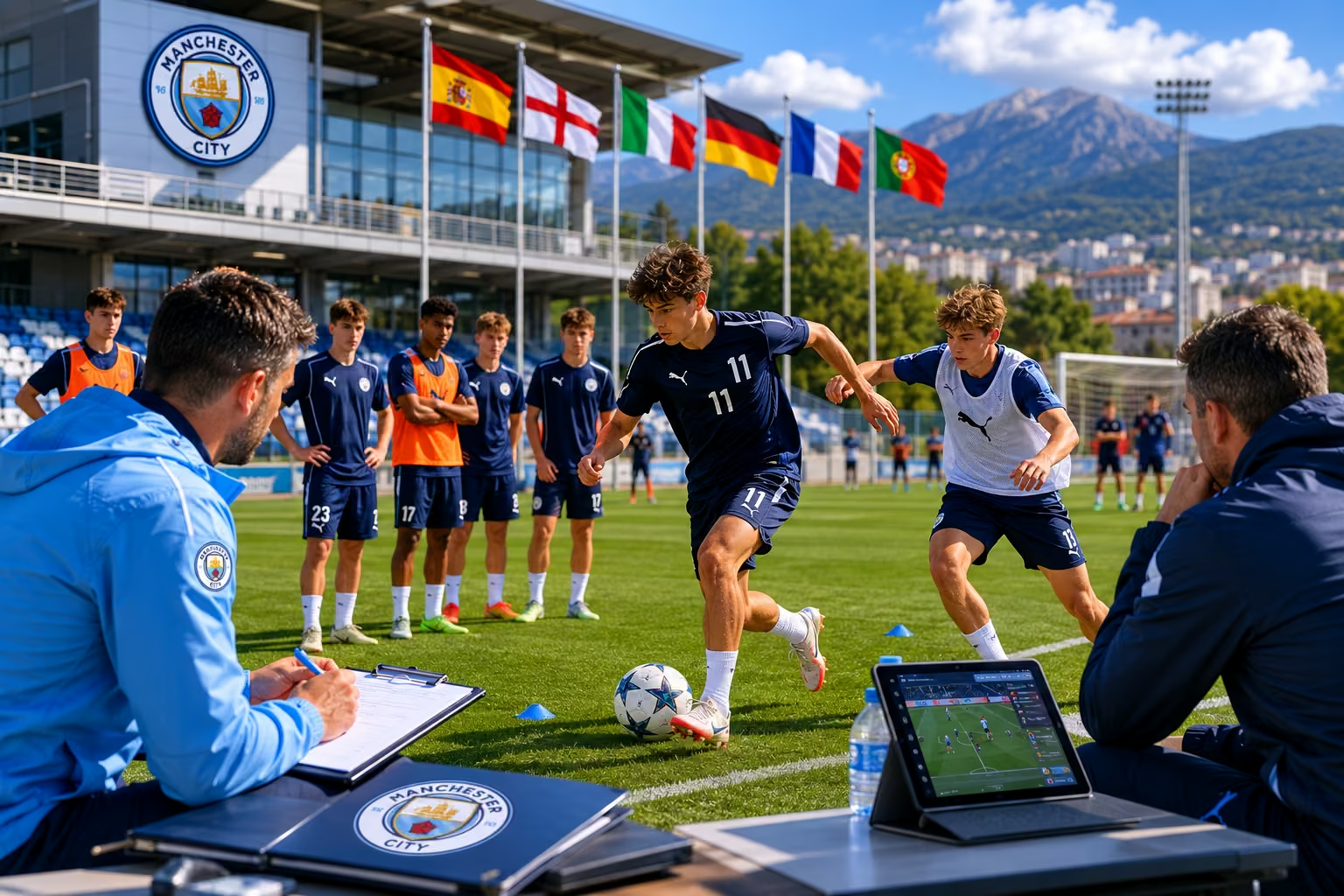
European football trials are structured opportunities for players to enter a professional club environment, train under club staff, and receive a realistic assessment of their current level. For players from North America and other international markets, they can be valuable when the player is ready, the club fit is appropriate, and the process is managed properly.
They can also be misunderstood. A trial is not a guaranteed signing, a shortcut into professional football, or a paid experience that automatically creates club interest. A serious trial is an evaluation. The club is assessing whether the player’s technical quality, tactical understanding, physical profile, mentality, professionalism, and overall fit match the environment.
Match Tour 11 supports players through structured European football trials by placing suitable players inside professional club settings across Europe for evaluation and honest feedback. For the right player, a trial can lead to further opportunities. For many players, it provides something equally important: clarity on where they stand and what they need to improve.
What Are European Football Trials?
European football trials are player evaluation opportunities hosted inside professional or semi-professional football environments. A player may train with a club, join age-appropriate or level-appropriate sessions, be observed by coaching staff, and receive feedback on whether their profile fits the club’s needs.
In a structured trial, the player is not simply attending a showcase. The objective is to place the player close to the club’s normal football rhythm. That may include daily training, tactical work, match-related exercises, physical demands, and observation by staff who understand the club’s level.
This is different from a camp. A camp is primarily a development experience. A trial is an assessment. A camp may help a player improve and understand higher standards, while a trial asks whether the player can already compete within a specific football environment.
European football trials are most useful when they are selective. A player should not be sent to a club simply because they want to go to Europe. The player should have a realistic profile, appropriate age, strong training habits, technical ability, competitive experience, and the maturity to handle feedback.
How Do European Football Trials Work?
European football trials usually begin with a player assessment. Before a club opportunity is considered, the player’s profile should be reviewed. This may include age, position, playing history, video, physical attributes, passport or eligibility considerations, current club level, references, and long-term objectives.
Once the profile is reviewed, the next step is club fit. A strong trial process does not send every player to the biggest available club. It identifies a football environment where the player can realistically be assessed. That may be a professional club, a reserve environment, a youth setup, a lower-division professional club, or a development-focused partner club.
Match Tour 11’s trial model includes structured two-week trial programs where individual players are integrated into a professional club’s daily training setup, evaluated by professional coaching staff, and given honest individual feedback. Current trial club partners include Sevilla FC, CD Leganes, Malaga CF, Marbella FC, SD Huesca, SK Austria Klagenfurt, Girona FC, FC Marbelli, and Como 1907, depending on player fit, timing, level, and availability.
During the trial, the player must adapt quickly. They are entering an environment where coaches may not explain every detail slowly. Players need to listen, observe, compete, and show their qualities without forcing the game. The best trial performances are usually not built on desperation. They are built on composure, quality, discipline, and consistency.
1. Understand That a Trial Is an Evaluation, Not a Guarantee
The first principle is simple: a trial is not a promise. European football trials do not guarantee a contract, academy place, roster spot, scholarship, scouting outcome, or future invitation.
This point matters because players and families can enter the process with unrealistic expectations. A club may like a player but not have an immediate roster need. A player may perform well but not match the club’s tactical profile. A club may need a different age, position, passport status, physical profile, or experience level.
That does not mean the trial has no value. A professional evaluation can help a player understand what the next step should be. The feedback may confirm that the player is close. It may show that the player needs another development year. It may reveal that a different league, country, or level is more appropriate.
A credible trial provider should be clear about this from the beginning. Match Tour 11’s approach should be understood as pathway support, not outcome guarantees. The role is to assess the player, identify suitable environments, facilitate placement where appropriate, and support the process honestly.
2. Know Who European Football Trials Are For
European football trials are for players who are ready to be evaluated in a serious football environment. They are not for every motivated player, and they are not always the right next step for a young player who still needs development time.
A suitable player may already be performing at a strong academy, semi-professional, collegiate, provincial, national, or professional development level. They may have a clear position, strong technical base, competitive experience, and the ability to train with intensity over multiple days.
Trials may be relevant for older youth players seeking a European benchmark, unsigned players looking for club opportunities, players returning from college or academy environments, or professionals searching for a new market. The common factor is readiness.
Parents should be careful with the idea that exposure alone creates opportunity. Exposure only matters when the player can meet the standard in front of the right people. If the player is not ready, a trial may create pressure without progress. In that case, a training camp, international tour, or development plan may be a smarter first step.
3. Build a Realistic Player Profile Before Contacting Clubs
A strong player profile is essential before pursuing European football trials. Clubs need to understand who the player is, what level they play at, what position they occupy, and why they may be relevant.
A useful profile may include the player’s full name, date of birth, nationality, passport status, height, position, dominant foot, current club, previous clubs, competitive level, video highlights, full-match footage, references, statistics where relevant, and short-term availability.
Video matters, but it must be honest. A highlight reel can introduce the player, but full-match footage often tells more. Coaches want to see decision-making, movement without the ball, defensive responsibility, physical output, recovery runs, communication, and consistency.
Players should avoid exaggerating their level. Overstating experience can damage credibility. A realistic profile helps Match Tour 11 identify suitable clubs and avoid placing a player in an environment that is too low, too high, or simply wrong for the player’s pathway.
4. Choose the Right Club Level, Not Just the Biggest Name
One of the most common mistakes in European football trials is chasing the most famous club name instead of the most appropriate football environment.
A trial at a major club can sound impressive, but if the player is not suited to that level, the experience may not create value. A more suitable lower-division professional club, development club, or partner environment may provide a better evaluation, more realistic feedback, and a stronger chance of future movement.
Club fit depends on many factors. Position depth matters. Age-group needs matter. Tactical style matters. Physical demands matter. Registration rules, passport considerations, timing, squad planning, and budget can all affect whether a club can seriously consider a player.
This is where Match Tour 11’s network and football-first approach becomes important. The company works across Europe and supports players through club identification, placement, and evaluation. The goal is not just to place a player somewhere. The goal is to place the player somewhere that makes football sense.
5. Prepare for the Daily Demands of a Trial Environment
European football trials can be physically and mentally demanding. A player may be training in a new country, with unfamiliar teammates, different coaching language, new tactical expectations, and a higher pace of play.
Preparation should begin before travel. Players should arrive fit, healthy, sharp, and rested. They should not attempt extreme extra training in the final days before departure. The objective is to arrive ready to perform, not fatigued from last-minute preparation.
Technical preparation should focus on clean habits. First touch, passing quality, receiving under pressure, scanning, body shape, speed of play, defending discipline, and finishing efficiency all matter. Tactical preparation should focus on understanding the role. A midfielder must show awareness and control. A defender must show reliability and positioning. A forward must show movement, timing, and end product.
Mental preparation is equally important. Players should expect mistakes. They should also expect correction. Coaches are watching how quickly a player adapts, how they respond to feedback, and whether they remain composed when the environment becomes difficult.
6. Understand What Clubs Actually Evaluate
European football trials are not judged only by goals, assists, tricks, or highlight moments. Clubs evaluate the complete player.
Technical quality is important. Coaches look at first touch, passing, dribbling, crossing, finishing, defending actions, ball speed, and the ability to execute under pressure. Tactical understanding is also critical. Players must know when to press, when to hold shape, when to play forward, when to recycle possession, and how to support teammates.
Physical qualities matter, but not in isolation. Speed, strength, agility, endurance, and power can help, but they must serve football actions. Mentality is often decisive. Coaches observe attitude, body language, resilience, focus, confidence, humility, and coachability.
Professional habits also matter. Punctuality, preparation, communication, nutrition, recovery, respect for staff, and behaviour around the team can influence the final assessment. A player on trial is being evaluated before, during, and after the session.
7. Avoid Common Mistakes During European Football Trials
Players often make mistakes because they feel pressure to impress quickly. That pressure can lead to forced dribbles, unnecessary shots, poor decision-making, emotional reactions, or trying to play outside the role.
The best approach is to show quality through the game. A central midfielder should not try to become a winger. A centre-back should not force risky passes every time. A forward should not ignore pressing responsibilities while waiting for chances. Coaches want to see whether the player can help the team.
Common mistakes include arriving unfit, ignoring tactical instructions, playing selfishly, reacting poorly to mistakes, treating training like a showcase, failing to communicate, underestimating the speed of play, and not adapting to feedback.
European football trials reward players who combine confidence with discipline. A player must show personality, but not at the expense of team structure. They must compete, but not lose control. They must stand out, but in ways that make football sense.
8. Use Feedback Properly After the Trial
The feedback after a trial can be one of the most valuable parts of the process. Not every trial ends with an offer. In fact, many trials end with development recommendations, future monitoring, or advice to pursue a different level.
Players and parents should listen carefully. If the feedback says the player needs more physical development, that should become part of the training plan. If the feedback identifies tactical gaps, the player should work with coaches to address those details. If the feedback says the player is close but needs match experience, the next step may be finding a better competitive environment.
A trial should produce clarity. It should help answer questions such as: Is the player ready for this level? Which market may fit better? What position does the player project into? What does the player need to improve over the next six months?
Match Tour 11’s structured approach to player trials and evaluations is valuable because honest feedback helps players make better decisions. A trial should not be treated as success or failure only. It should be treated as information.
9. Know When Player Management Becomes Relevant
For players who are ready to compete professionally, European football trials may connect to broader player management support. This is different from simply attending a trial.
Player management may include assessing the player profile, identifying suitable clubs, facilitating introductions, supporting placement, helping with the contract process from offer to agreement, and staying involved after signing. Match Tour 11 provides player management and professional signings for players who are ready for that level of support.
This stage requires realism. A player should not seek management simply because they want to be professional. Management becomes relevant when the player has a credible profile, market fit, and realistic opportunity to secure a professional or semi-professional placement.
For the right player, a trial can be one step in that process. For other players, the smarter step may be more development, another competitive season, a training camp, or a more suitable trial environment later.
What Happens During a Two-Week European Trial Program?
A two-week trial program gives the club more time to evaluate the player than a short showcase or single-session assessment. It also gives the player more time to adapt.
The first days are often about settling in. The player must understand the training rhythm, coaching language, facility setup, teammates, and expectations. Coaches may observe how quickly the player adapts and whether they can handle the tempo.
As the trial continues, the player may be assessed in more specific situations. Coaches may watch technical execution, role understanding, decision-making, physical output, match play, and behaviour around the group. If the player improves during the trial, that can be a positive sign because it shows learning capacity.
At the end, the player may receive feedback. Depending on the situation, the club may express interest, recommend further monitoring, suggest another level, or determine that the player is not currently the right fit. None of these outcomes should be treated casually. Each can guide the next decision.
How Should Parents Evaluate a Trial Opportunity?
Parents should evaluate European football trials carefully before committing. The most important questions are about credibility, fit, communication, safety, and realistic outcomes.
Questions parents should ask
- Which club or clubs may evaluate the player?
- Is the trial suitable for the player’s age, position, and current level?
- Who will coordinate the player’s placement and local support?
- How long is the trial period?
- What training environment will the player enter?
- What feedback will the player receive?
- What outcomes are realistic?
- What costs are involved, and what is included?
- What happens if the club does not offer a next step?
Families should be cautious with anyone promising guaranteed contracts, guaranteed scouts, guaranteed professional placement, or guaranteed selection. Serious football does not work that way. A credible pathway is built on assessment, preparation, fit, and honest communication.
How Can Players Prepare Before Going to Europe?
Players should prepare for European football trials with a clear plan. Preparation should include football training, physical readiness, video review, travel readiness, and mental discipline.
Player preparation checklist
- Review recent match footage and identify recurring strengths and weaknesses.
- Train position-specific actions under pressure.
- Arrive fit, but avoid overtraining immediately before travel.
- Prepare boots and equipment suitable for the expected surface.
- Understand the club, country, and likely football style.
- Clarify travel documents, insurance, accommodation, and local logistics.
- Set realistic objectives for the trial.
- Prepare mentally to receive feedback and adapt quickly.
The best players treat preparation professionally. They do not wait until they arrive in Europe to start thinking seriously. They prepare their body, their football habits, and their mindset before the first session.
How Match Tour 11 Supports European Football Trials
Match Tour 11 supports individual players by assessing player profiles, identifying suitable club environments, coordinating structured trial opportunities, and helping players understand the feedback and next steps.
The company’s player trials and evaluations service is designed for players who are serious about testing themselves in professional European football environments. Match Tour 11 works with club partners across Europe, including Spain, Austria, and Italy, and supports players through a realistic pathway process.
For some players, the right first step may not be a trial. A player may need an international football tour, a training camp, more match footage, or further development before entering a trial environment. Match Tour 11 also provides international football tours, training camps, and international tournaments that can support earlier stages of the pathway.
For players who are ready to pursue professional opportunities, Match Tour 11 can also support player management and signing processes. The most important point is fit. The right service depends on the player’s level, age, goals, and readiness.
Useful Football Development Resources
Players, parents, and coaches can use credible development resources to better understand the football environment around trials. The FIFA Training Centre provides player and coach development content. UEFA offers information on coach development, coaching courses, and grassroots football programmes. Canadian players and families can also review the Canada Soccer ecosystem to understand the domestic development structure before evaluating international opportunities.
These resources are not trial placement tools. They are useful reference points for understanding development standards, coaching education, and player pathway context.
Common Questions About European Football Trials
Do European football trials guarantee a contract?
No. European football trials do not guarantee a contract, signing, academy place, or future invitation. They are evaluation opportunities.
How long does a trial usually last?
Trial length can vary. Match Tour 11’s structured trial programs are commonly built around a two-week club environment, depending on the player, club, timing, and availability.
Can North American players attend trials in Europe?
Yes. North American players can attend trials in Europe when the player profile is suitable and the opportunity is properly coordinated. Readiness, eligibility, level, and club fit are important.
What happens if a player is not selected?
The player should use the feedback to guide the next step. That may include more development, a different level, another market, additional match footage, or a future trial when the player is better prepared.
Are trials only for elite players?
Trials are for players who are ready to be evaluated in a serious football environment. That does not always mean famous or already professional, but the player must have a credible level and the maturity to handle assessment.
Final Thoughts on Choosing the Right Trial Pathway
European football trials can be valuable for the right player at the right time. They provide exposure to professional club environments, honest evaluation, and a clearer understanding of what the player needs next. They can also create real opportunities when the player’s level, profile, and club fit align.
The mistake is treating a trial as a shortcut. A trial is not a guarantee. It is a test. Players who succeed are usually prepared, realistic, coachable, technically reliable, tactically aware, and mentally resilient.
For players and families, the best approach is to start with an honest assessment. Is the player ready? Which level makes sense? What does the player profile show? What would be a useful outcome even if there is no signing? These questions lead to better decisions.
Match Tour 11 helps players navigate European football trials through structured evaluations, club relationships, pathway planning, and honest feedback. To discuss whether a player may be ready for a European trial program, contact Match Tour 11 with the player’s age, position, current club, video, passport status, and football objectives.