Professional Club Trial Experiences for Players Entering Spain or Austria
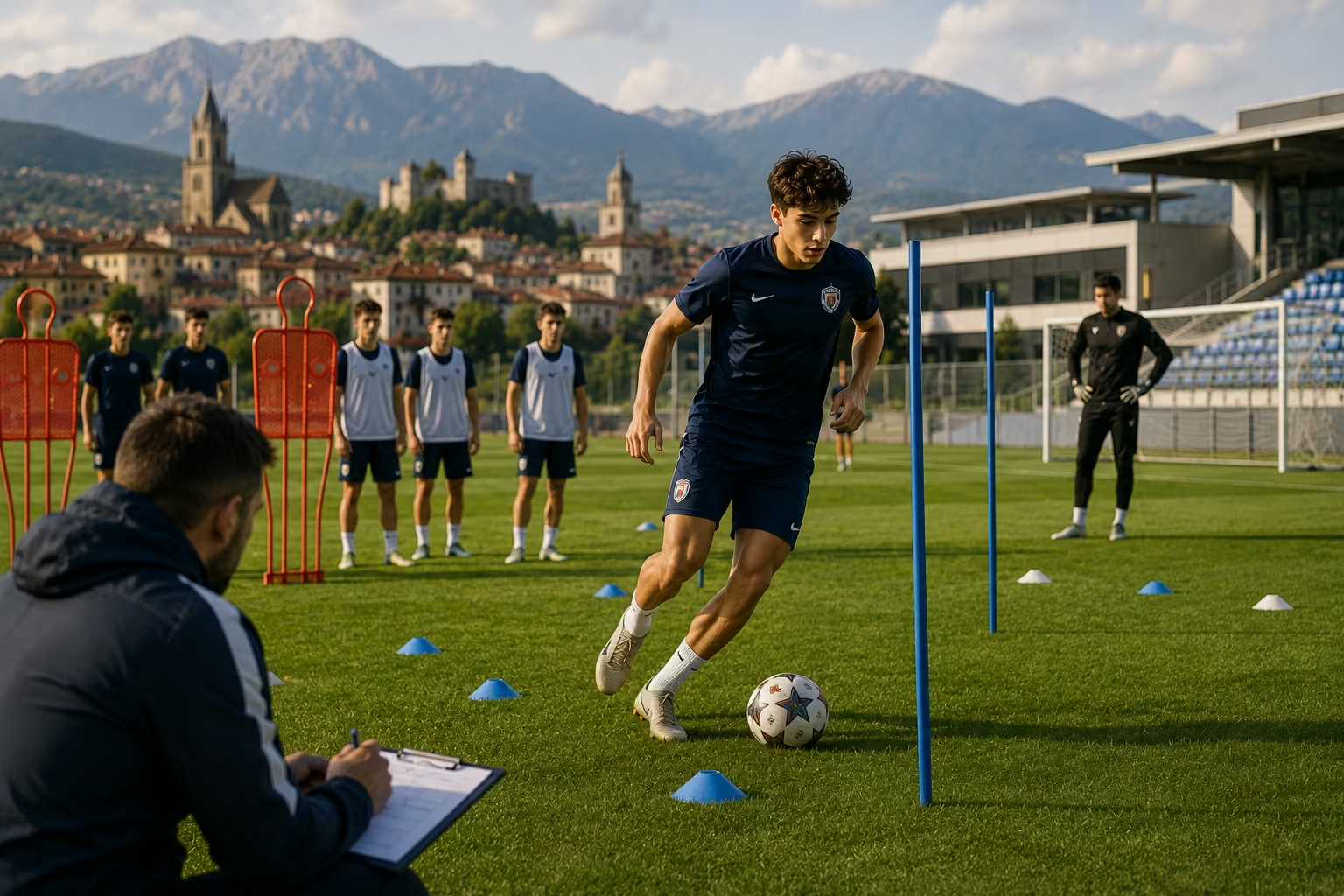
A two-week football trial gives players a serious opportunity to enter a professional club environment, train inside the club’s daily rhythm, and receive an honest assessment of their current level. For players from Canada, North America, and other international markets, this type of trial can provide a much clearer benchmark than a short showcase or one-day evaluation.
Spain and Austria both offer strong football environments, but they are not identical. Spain often places heavy emphasis on technical detail, positional play, decision-making, and comfort under pressure. Austria can provide a demanding Central European setting where physical readiness, tactical structure, training intensity, and adaptability are important. The right destination depends on the player’s profile, position, level, timing, and club fit.
Match Tour 11 supports suitable players through structured player trials and evaluations across Europe. The goal is not to guarantee a professional contract, signing, scouting outcome, or club selection. The goal is to place the right player in the right environment, support the trial process, and help the player understand what the evaluation means for their pathway.
What Is a Two-Week Football Trial?
A two-week football trial is a structured evaluation period where a player trains inside a professional or serious club environment for roughly two weeks. During that time, the player may join regular training sessions, participate in position-specific exercises, compete in small-sided games, adapt to tactical instructions, and be observed by professional coaching staff.
The main purpose is evaluation. The club wants to understand whether the player can handle the level, fit the training environment, respond to feedback, and potentially match the needs of the squad. For the player, the trial provides exposure to professional standards and a realistic view of what must improve.
This is different from a football camp. A camp is primarily built for development and learning. A trial is more direct. It asks whether the player is ready to be assessed by a club. It is also different from a team tour, which may combine training, matches, travel, and cultural experiences for a full group.
Match Tour 11’s player trials and evaluations are designed for players who are ready for that kind of assessment. Players are integrated into club environments, evaluated by professional staff, and given honest feedback that can guide future decisions.
Why Two Weeks Matters
A two-week football trial gives both the player and the club more time than a single session or short showcase. One day can be misleading. A player may be nervous, tired from travel, unfamiliar with the language, or slow to adapt. A longer trial gives the player time to settle and gives coaches more time to observe consistency.
In the first few days, the club may watch how quickly the player adjusts. Coaches may look at body language, technical habits, communication, fitness, and whether the player understands the pace of the environment. The player may not be expected to dominate immediately, but they must show learning capacity and professionalism.
By the middle of the trial, coaches may begin forming a clearer view. They can see whether the player repeats good habits or only shows isolated moments. They can assess whether the player improves after feedback. They can also evaluate whether the player’s position, physical profile, and tactical qualities make sense for the club.
By the end of the two weeks, the player should have more useful information. That may include positive club interest, a recommendation for further development, advice to pursue a different level, or confirmation that the player needs more preparation before another European opportunity.
1. Expect a Real Football Environment, Not a Showcase
The first thing players should understand is that a professional club trial is not designed like a showcase. A showcase often puts many players into a display format where the objective is to catch attention quickly. A club trial is different. The player is entering a football environment that already has its own rhythm, standards, schedule, and expectations.
Players may train with a squad that is already familiar with the coaching staff, tactical language, and daily habits. The trialist has to enter that setting and adapt. This requires humility and awareness. The player must show quality without disrupting the session or forcing unnecessary actions.
Coaches are not only looking for highlight moments. They are looking at how the player fits into the group. Does the player understand spacing? Does the player communicate? Does the player follow instructions? Does the player recover after mistakes? Does the player make the team better?
This is why preparation matters. A player entering a two-week football trial should arrive ready to train seriously from the first session.
2. Expect the First Days to Be About Adaptation
The first two or three days are often the adjustment period. The player may be dealing with travel fatigue, new food, a different climate, unfamiliar teammates, and a coaching style that feels different from home.
In Spain, the player may notice a strong focus on technical security, quick circulation, positional discipline, and playing under pressure. In Austria, the player may notice directness, structure, athletic demand, and high training intensity. These are broad tendencies, not fixed rules, but players should be ready for different football habits.
During this stage, coaches may be watching how the player processes information. A player who listens carefully and improves quickly can make a strong impression even before producing major standout moments.
The worst mistake is panic. Players sometimes believe they must impress immediately, so they force dribbles, rush passes, or abandon their role. The better approach is to settle into the session, play clean football, communicate clearly, and show that the environment is not too much.
3. Expect Coaches to Evaluate More Than Technical Ability
Technical ability matters, but it is only one part of the evaluation. Coaches also assess tactical understanding, physical readiness, mentality, professionalism, and how the player behaves around the group.
A midfielder may have good passing range, but coaches will also watch scanning, body shape, defensive positioning, tempo control, and decision-making under pressure. A winger may be quick, but coaches will also assess end product, pressing, timing, and defensive responsibility. A centre-back may be strong, but coaches will look closely at positioning, communication, composure, and decision-making when building from the back.
Physical qualities are also evaluated in context. Speed, strength, balance, endurance, agility, and repeated sprint ability can all matter, but they must support football actions. A fast player who makes poor decisions may struggle. A technically clean player who cannot handle match tempo may also struggle.
Mentality is often decisive. Coaches notice whether a player responds well to correction, competes honestly, stays focused, and handles pressure without emotional drop-off.
4. Expect Training to Test Your Position-Specific Habits
A two-week football trial is not only about general ability. The club is evaluating whether the player can perform their specific role.
Goalkeepers may be assessed on shot-stopping, distribution, communication, handling, footwork, and presence. Centre-backs may be judged on defensive reliability, aerial ability, passing decisions, line management, and composure. Fullbacks may be tested on 1v1 defending, recovery runs, crossing, support angles, and tactical discipline.
Midfielders may be evaluated on scanning, receiving under pressure, speed of play, defensive transitions, and ability to connect the team. Wingers may be assessed on creativity, pressing, decision-making, crossing, finishing, and 1v1 effectiveness. Strikers may be judged on movement, finishing, hold-up play, pressing, timing, and ability to create separation.
Players should prepare for their role before arriving. A trial is not the time to discover what the position requires. It is the time to prove that the player can execute those requirements inside a demanding environment.
5. Expect Honest Feedback, Not Constant Praise
Players from North America may be used to coaching environments where encouragement is frequent and feedback is softened. In a professional European setting, feedback can be more direct. That does not mean the environment is negative. It means the focus is on performance and improvement.
During a trial, coaches may correct technical details, tactical decisions, positioning, body shape, timing, communication, or effort. The player’s response matters. A player who takes correction personally may struggle. A player who listens, adjusts, and applies feedback quickly can strengthen their evaluation.
Parents should also understand this. A coach correcting a player is not always a bad sign. In many cases, it means the coach is giving the player an opportunity to improve. The key is whether the player can process the feedback and change behaviour.
At the end of the trial, feedback should help the player understand the next step. That may be continued interest, further development, a different level, or preparation for another opportunity later.
6. Expect Spain and Austria to Challenge Players Differently
A football trial in Spain and a football trial in Austria can feel different. The best choice depends on the player’s profile.
Spain may be especially useful for players who need to test their technical security, decision-making speed, first touch, passing angles, and ability to operate in tight areas. Players may be challenged to think faster, support teammates intelligently, and avoid careless possession losses.
Austria may be useful for players who need to test their physical output, tactical discipline, directness, transition habits, and ability to compete in a structured Central European environment. Players may need to show that they can handle tempo, intensity, and repeated football actions.
Match Tour 11 has trial partners in both markets, including clubs in Spain and Austria. Current trial club partners include Sevilla FC, CD Leganes, Malaga CF, Marbella FC, SD Huesca, Girona FC, FC Marbelli, and SK Austria Klagenfurt, depending on timing, player level, position, and availability.
The right trial is not the one with the most famous name. It is the one where the player can be evaluated properly and where the club environment matches the player’s realistic pathway.
7. Expect Daily Professional Habits to Matter
During a two-week football trial, the player is being evaluated beyond the ball. Daily habits matter.
Players should be punctual, organized, respectful, and prepared. They should bring the correct equipment, manage hydration, eat properly, sleep well, and recover between sessions. They should avoid unnecessary distractions and treat the trial as a professional assessment, not a football vacation.
Staff may notice how the player interacts with teammates, listens during meetings, handles language barriers, and behaves when not directly involved in an exercise. These details can influence perception.
Professional clubs want players who can be trusted inside a team environment. Talent can open the door, but daily behaviour helps determine whether the player belongs.
8. Expect Some Discomfort and Pressure
A trial should feel demanding. The player is entering an unfamiliar environment where performance matters. There may be pressure to impress, pressure to adapt, and pressure to handle mistakes.
This is normal. A player who expects everything to feel comfortable may be surprised. The trial may expose weaknesses. The pace may feel quicker. The coaching may be direct. The player may not understand every tactical instruction immediately. Teammates may not always communicate in English.
The key is composure. Players should focus on controllable behaviours: work rate, concentration, communication, positioning, simple decisions, and response to feedback. They should not judge the entire trial on one poor session.
Coaches understand that adaptation takes time. What matters is whether the player improves, competes, and shows enough quality to justify further consideration.
9. Expect the Club to Consider Timing and Squad Needs
Even if a player performs well, club decisions depend on more than the trial performance. Timing matters. Squad needs matter. Position depth matters. Age category, passport status, registration rules, budget, and club planning can all affect the outcome.
A player may be good enough to interest a club, but the club may already have several players in the same position. Another player may be technically strong but not match the physical profile needed. A club may like a player but prefer to monitor them longer before making a decision.
This is why players should avoid thinking only in terms of success or failure. A trial can create useful feedback even when there is no immediate offer. It can show what level is appropriate, what market may fit better, and what the player needs to improve.
Match Tour 11 helps players interpret these outcomes realistically. A serious pathway is built through assessment, feedback, development, and the right next move.
10. Expect the Final Days to Clarify the Next Step
Near the end of a two-week football trial, the player should have a clearer sense of the environment. Coaches may also have a clearer view of the player’s qualities and limitations.
The final days can be important because they show consistency. A player who starts slowly but improves may leave a positive impression. A player who begins strongly but fades physically or mentally may raise questions. A player who applies feedback across the two weeks can show coachability and development potential.
The outcome may take different forms. The club may express interest. The club may recommend further monitoring. The player may be advised to seek another level. The feedback may identify technical, tactical, physical, or mental areas for improvement.
Players and families should treat this information seriously. If the feedback is honest, it can guide the next six to twelve months of development.
11. Expect the Trial to Connect to a Wider Pathway
A two-week football trial is one step inside a larger pathway. For some players, it may lead to further club conversations. For others, it may show that more development is needed. Both outcomes can be valuable if the player uses the information properly.
Players who are close to professional readiness may need ongoing representation, club communication, and placement support. Match Tour 11 offers player management and professional signings for players who are ready to compete professionally and need support through the club identification, placement, and contract process.
Players who are not ready for management may still benefit from training camps, international football tours, stronger competition, or a future trial at a more suitable level. Match Tour 11 also provides training camps, international football tours, and international tournaments for players and teams at different stages.
The right pathway depends on age, level, position, goals, readiness, and timing. A credible process should not force every player into the same solution.
What Should Players Bring to a Two-Week Trial?
Players should arrive prepared for a professional environment. Exact requirements may vary by club and destination, but preparation should be disciplined.
Player preparation checklist
- Valid passport and any required travel documents.
- Appropriate boots for expected surfaces.
- Shin guards and training gear.
- Recovery clothing and weather-appropriate layers.
- Personal hydration and nutrition habits.
- Updated player profile and video links.
- Medical information where required.
- A clear understanding of position-specific objectives.
- A professional attitude toward feedback, punctuality, and daily preparation.
The practical details matter because they reduce stress. A player who is organized off the pitch can focus more effectively on performance.
How Should Players Prepare Before Traveling?
Players should prepare physically, technically, tactically, and mentally before traveling to Spain or Austria. Last-minute preparation is not enough.
Physically, players should arrive fit and healthy. They should not overtrain immediately before departure. The final week should protect sharpness, mobility, sleep, and recovery.
Technically, players should focus on clean actions under pressure. First touch, passing quality, scanning, receiving across the body, defending habits, finishing, crossing, and position-specific repetition should all be part of preparation.
Tactically, players should review their role. They should understand what their position requires in possession, out of possession, and in transition. They should watch recent match footage and identify patterns in their own game.
Mentally, players should prepare for correction, pressure, and uncertainty. A trial is not a comfortable environment by design. The player must be able to stay composed and continue learning.
What Should Parents Understand Before Sending a Player?
Parents should understand that a two-week football trial is an evaluation opportunity, not a guaranteed outcome. The player may receive positive feedback, continued interest, development advice, or no immediate next step.
Before committing, parents should ask practical questions about the club environment, player suitability, schedule, accommodation, local support, communication, feedback, and realistic outcomes.
Questions parents should ask
- Is the player ready for this level?
- Why does Spain or Austria fit the player profile?
- Which club environment may evaluate the player?
- How long is the trial and what does the schedule include?
- What support is provided during the trial?
- What feedback should the player expect?
- What outcomes are realistic?
- What happens if there is no offer?
Families should be cautious with anyone promising guaranteed signings, guaranteed scouts, guaranteed contracts, or guaranteed club placement. Serious football evaluation does not work that way.
How Match Tour 11 Supports Trial Players
Match Tour 11 supports suitable players by assessing their profile, identifying appropriate club environments, coordinating structured trial access, and helping players understand the feedback and pathway options after the evaluation.
As an international football agency and sports tourism brand based in North Vancouver, British Columbia, Match Tour 11 operates across North America and Europe. The company connects players, teams, clubs, academies, and school football programs with professional football environments through tours, camps, trials, evaluations, management, and signing support.
For players entering Spain or Austria, Match Tour 11’s role is to make the process more realistic and better aligned. The company does not simply send players anywhere. The goal is to understand the player’s profile and place them where the evaluation makes football sense.
For the right player, a two-week football trial can be an important step. For another player, the correct advice may be to develop further before trialing. That honesty protects the player, the family, and the club relationship.
Useful Football Development Resources
Players, parents, and coaches can use credible development resources to better understand the football environment around trials. The FIFA Training Centre provides player and coach development content. UEFA offers information on coach development, coaching courses, and grassroots football programmes. Canadian players and families can also review the Canada Soccer ecosystem to understand the domestic development landscape before pursuing international opportunities.
These resources do not replace a club evaluation, but they can help families frame the trial process with better context.
Common Questions About a Two-Week Football Trial
Does a two-week football trial guarantee a contract?
No. A two-week football trial does not guarantee a professional contract, signing, academy placement, scouting outcome, or future invitation. It is an evaluation opportunity.
Is Spain or Austria better for a football trial?
The better destination depends on the player. Spain may suit players who need to test technical security and decision-making. Austria may suit players who need to test physical output, tactical discipline, and Central European match intensity.
Can Canadian or North American players trial in Spain or Austria?
Yes. Canadian and North American players can trial in Spain or Austria when their profile is suitable, the club fit is realistic, and the opportunity is properly coordinated.
What happens after the trial?
The player may receive feedback, continued interest, a recommendation for another level, or advice to develop further before another opportunity. The outcome depends on performance, club needs, timing, and fit.
Who should consider a two-week football trial?
A two-week football trial is best suited for players who are ready for serious evaluation. This may include strong academy players, semi-professional players, collegiate players, unsigned professionals, or advanced youth players with credible match footage.
Final Thoughts on Trialing in Spain or Austria
A two-week football trial in Spain or Austria can be a valuable step for the right player. It gives the player time to adapt, allows coaches to evaluate consistency, and provides a more realistic benchmark than a short showcase.
The most important factor is fit. The player should be ready for the environment, the club should make sense for the player’s level, and the expectations should be clear from the beginning.
Players should enter the process prepared, humble, competitive, and open to feedback. Parents should evaluate the opportunity based on credibility, support, and realistic outcomes. Coaches should understand that even a non-signing result can provide useful development information.
Match Tour 11 supports suitable players through structured football trials and evaluations in Europe, including opportunities connected to professional club environments in Spain and Austria. To discuss whether a player may be ready for a two-week football trial, contact Match Tour 11 with the player’s age, position, current club, video, passport status, and football objectives.