European Football Opportunities for Canadian Players and Teams

The football pathway from Canada to Europe is not one single route. For most players, it is a staged process built through development, exposure, honest evaluation, appropriate competition, and the right football contacts at the right time.
Some players begin with an international football tour as part of a team. Others attend a professional training camp to experience a higher standard. Some are ready for individual player trials and evaluations inside European club environments. A smaller group may be close enough to professional football to need player management and signing support.
Match Tour 11 supports this pathway by connecting Canadian players, teams, academies, clubs, and school football programs with professional football environments across North America and Europe. The company’s work includes international football tours, training camps, international tournaments, player trials, player evaluations, player management, and professional signing support.
The important point is realism. A European pathway should never be presented as a guaranteed contract, guaranteed scouting result, guaranteed trial, or guaranteed signing. The right pathway depends on the player’s level, age, position, maturity, passport status, video, club fit, timing, and readiness.
What Does a Football Pathway From Canada to Europe Actually Mean?
A football pathway from Canada to Europe means creating structured opportunities for players or teams to train, compete, learn, and be evaluated in international football environments. It does not mean every player should immediately chase a professional trial. It means identifying the right next step based on the player’s current stage.
For a young academy player, the first step may be an international football tour or a development camp. For a team, the best step may be a European tour that includes professional training, competitive matches, stadium experiences, and cultural learning. For an older or more advanced player, the right step may be a structured trial in Spain, Austria, Italy, or another market where the player can be assessed honestly.
The pathway should be progressive. Players need the right challenge at the right time. If the opportunity is too easy, it does not create enough growth. If it is too advanced, it can create pressure without useful progress. A credible football pathway helps match the opportunity to the player’s actual level.
Match Tour 11’s role is to help players and teams understand those stages and access football environments that make sense. That may include international football tours, training camps, player trials and evaluations, or player management and professional signings.
1. Start With a Clear Player or Team Assessment
The first step in any pathway is assessment. Before choosing Europe, a camp, a tour, or a trial, players and teams need to understand their current level and objectives.
For individual players, this means reviewing age, position, current club, playing history, physical profile, technical ability, tactical understanding, match footage, passport status, and long-term goals. A player may want Europe, but the question is whether Europe is the right next step now.
For teams, assessment means understanding the group’s age, competitive level, travel experience, coaching goals, budget, schedule, and development needs. A U13 academy team needs a different international experience than a U17 high-performance group or a school football program.
This assessment prevents poor decisions. Not every player needs a trial. Not every team needs the most intense itinerary. Not every academy should chase the biggest club name. The correct starting point is honest evaluation.
2. Use Football Tours to Build International Exposure
For many Canadian teams, the pathway begins with a football tour. A tour gives players controlled exposure to international training environments, competitive matches, travel demands, and different football cultures.
Match Tour 11 organizes end-to-end football tours for teams traveling to Europe. These tours may include professional training at club facilities, competitive matches against local opposition, stadium tours, live professional football, city and cultural experiences, accommodation, ground transportation, meals, and full coordination.
Tour destinations may include Madrid, Manchester, Girona, Como, Marbella, Seville, Barcelona, and Klagenfurt. The right destination depends on the team’s age, level, travel window, and football objectives.
For Canadian academies, tours can create a valuable benchmark. Players experience different styles of play, different coaching language, and new competitive standards. Coaches can observe how players adapt, communicate, manage travel, respond to pressure, and behave outside their normal environment.
This is why tours are a useful part of the football pathway from Canada to Europe. They expose players to the standard without immediately forcing an individual trial decision.
3. Use Training Camps to Build Better Habits
Training camps can support players who need a professional learning environment before they are ready for formal evaluation. A good camp helps players improve technical habits, tactical awareness, communication, speed of play, and training discipline.
Match Tour 11 delivers two types of training camps. The first includes independent camps at top European club facilities with qualified coaches. The second includes official City Football Group training camps across Canada under the Manchester City Football School brand, coached by Manchester City Academy staff and built around the City methodology.
Current British Columbia camp locations include West Vancouver, Kelowna, and Richmond. For Canadian players, this creates a practical access point. Players can experience a professional training methodology in Canada before deciding whether an international tour, tournament, or trial may be appropriate later.
Training camps are especially useful when players need better habits rather than immediate exposure. A player may need sharper first touch, better scanning, improved body shape, more disciplined defending, or faster decision-making. Camps can give players the coaching references they need before stepping into a more demanding environment.
4. Understand the Role of the City Football Group Partnership
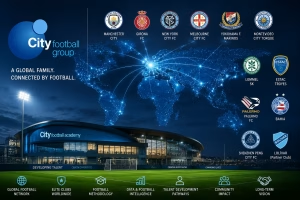
Match Tour 11 is the exclusive City Football Group partner for Canada. This gives Canadian players and teams access to the CFG network, including Manchester City and Girona FC.
This partnership is an important trust signal, but it should be understood correctly. It does not mean every player is guaranteed a trial, scouting outcome, academy place, or professional opportunity. Instead, it gives Canadian players and teams access to official programming, training environments, and pathway conversations connected to a globally recognized football group.
The City Football Group partnership can be especially relevant for players attending Manchester City Football School camps in Canada or teams considering destinations such as Manchester or Girona. It helps connect Canadian development experiences with international football standards.
For parents and academy directors, this matters because credibility is essential. A football pathway should be built through real football relationships, not vague promises or generic travel packages.
5. Use International Tournaments for Competitive Testing
International tournaments can be valuable for teams that need competitive pressure in a structured environment. A tournament can test the team’s match management, physical recovery, tactical adaptability, and emotional control across several games.
Unlike a single friendly match, a tournament creates repeated tests. Players may need to perform on short rest, adapt to different opponents, manage results, and stay focused throughout the event. Coaches can observe how players respond to pressure and how the team handles adversity.
Match Tour 11 supports international tournaments as part of its broader service model. For some teams, a tournament may be the right step after a development tour. For others, it may be a way to benchmark a high-performance group against stronger international opposition.
Tournaments should still be chosen carefully. The level must be appropriate. Too easy, and the team gains little. Too difficult, and the experience can become discouraging rather than developmental. The objective is useful competition.
6. Know When a Player Is Ready for a Trial
A trial is not the first step for every player. It is an evaluation opportunity for players who are ready to be assessed in a serious club environment.
Players may be ready for a trial if they already perform at a strong academy, semi-professional, collegiate, provincial, national, or professional development level. They should have credible match footage, a clear player profile, strong training habits, and the maturity to handle feedback.
A player who is still developing may benefit more from camps, tours, stronger domestic competition, or another season of match experience before pursuing Europe. This is not a setback. It is pathway discipline.
Parents should be cautious with any provider who treats every motivated player as trial-ready. A credible football pathway from Canada to Europe should protect players from entering the wrong environment too early. The goal is not just to get a trial. The goal is to get the right trial at the right time.
7. Understand How Player Trials and Evaluations Work
Match Tour 11’s player trials and evaluations place individual players inside professional club environments across Europe for structured two-week trial programs. Players are integrated into the club’s daily training setup, evaluated by professional coaching staff, and given honest individual feedback.
Current trial club partners include Sevilla FC, CD Leganes, Malaga CF, Marbella FC, SD Huesca, SK Austria Klagenfurt, Girona FC, FC Marbelli, and Como 1907, depending on player fit, timing, level, and availability.
During a trial, clubs assess the complete player. Technical ability matters, but so do tactical understanding, physical readiness, mentality, professionalism, communication, and coachability. A player is being evaluated before, during, and after training.
The result may be club interest, further monitoring, feedback for development, a recommendation for another level, or no immediate next step. None of those outcomes should be misunderstood. The purpose of evaluation is to create clarity.
8. Build a Professional Player Profile Before Seeking Europe
A player profile is essential for serious European conversations. Clubs and representatives need to understand who the player is, where they have played, what level they are currently at, and why they may be relevant.
A strong profile should include full name, date of birth, nationality, passport status, height, position, dominant foot, current club, previous clubs, league level, representative experience, references, highlight video, full-match footage, and availability.
Video should be honest. A highlight reel can introduce a player, but full-match footage often tells more. Clubs want to see decision-making, movement without the ball, defensive responsibility, body language, recovery runs, and consistency.
Players should avoid exaggerating their level. Overstating achievements or presenting unclear footage can damage credibility. A realistic profile helps Match Tour 11 identify suitable environments and avoid poor club fit.
9. Choose the Right European Market
Europe is not one single football market. Spain, England, Italy, Austria, and other countries each have different football cultures, playing styles, registration realities, and club structures.
Spain may suit players who are technically secure, tactically aware, and comfortable in possession. Italy may test tactical discipline, defensive intelligence, and professional habits. Austria may suit players who can handle physical output, structure, transition moments, and Central European training intensity. England can provide a demanding football culture, but entry points can be complex and highly competitive.
The right market depends on the player’s profile. A winger, goalkeeper, centre-back, midfielder, and striker may each require different pathway planning. Age, passport status, club needs, and timing also matter.
Players should avoid choosing Europe based only on reputation. The smarter decision is to choose the environment where the player can be evaluated properly and where the next step makes football sense.
10. Know When Player Management Becomes Relevant
Player management becomes relevant when a player is ready to pursue professional opportunities and needs support through club identification, placement, negotiation, and signing processes.
Match Tour 11 provides player management services for players ready to compete professionally. This includes assessing the player profile, identifying suitable clubs across the international network, facilitating placement, supporting the contract process from offer to agreement, and staying involved after signing.
This stage is different from attending a camp or trial. Management is for players with a credible professional profile or serious opportunity. It requires readiness, market fit, and realistic club interest.
Players supported by Match Tour 11 include Andy Owusu, Sarvin Saini, Predrag Simovic, Reece Curtis, and Matt Verbeek. These examples show the company’s involvement in professional pathway support, but every player’s situation is different.
For most players, management is not the first step. It becomes relevant after development, assessment, and opportunity begin to align.
11. Avoid Common Pathway Mistakes
Many players and families make similar mistakes when pursuing Europe. The most common mistake is chasing the biggest name instead of the right fit.
A famous club may sound impressive, but if the player is not ready for that environment, the opportunity may not produce useful feedback. A more suitable lower-division professional club, development environment, or partner club may provide a better evaluation.
Another mistake is treating exposure as the same thing as readiness. Being seen is only useful if the player can perform at the required level. Players need preparation, match footage, technical habits, tactical awareness, and emotional maturity before serious European evaluation.
Families should also avoid any promise of guaranteed contracts, guaranteed scouts, guaranteed trials, or guaranteed signings. Professional football does not work that way. A credible provider should explain what can be arranged, what depends on availability, and what outcomes are realistic.
12. Connect Each Step to a Long-Term Development Plan
The best football pathway from Canada to Europe is not random. Each step should connect to a long-term plan.
A player may begin with a Manchester City Football School camp in Canada, then join an international tour with their academy, then build stronger match footage, then pursue a structured European trial when ready. Another player may begin with a team tour, receive feedback, develop for another season, and later explore individual evaluation.
Teams can follow a similar model. A club may use international tours to benchmark its players, training camps to reinforce methodology, tournaments to test competition readiness, and trials for selected players who are prepared for individual assessment.
The pathway should remain flexible. Players develop at different speeds. Some mature early. Some need more time. Some are better suited to Europe. Others may find stronger opportunities in North America, college, semi-professional football, or another market.
The point is to make decisions based on football evidence, not pressure or emotion.
Example Pathways for Canadian Players and Teams
Young academy player
A young academy player may begin with a professional training camp in Canada, such as a Manchester City Football School program through Match Tour 11. The goal is to build better habits, experience higher coaching detail, and understand development standards before pursuing international travel.
Academy team seeking international exposure
A Canadian academy team may travel to Spain, England, Italy, or Austria for a football tour. The itinerary may include training sessions, competitive matches, cultural experiences, stadium visits, and team meetings. The objective is development, not guaranteed scouting.
Advanced player seeking evaluation
An older player with strong match footage, clear position profile, and serious competitive experience may be considered for a two-week trial in Europe. The trial should match the player’s level and provide honest feedback from professional staff.
Player ready for professional opportunity
A player who has the level, maturity, profile, and market fit may need player management. At this stage, the process may involve club identification, placement discussions, contract support, and ongoing representation.
How Parents Should Evaluate the Pathway
Parents should evaluate the pathway based on credibility, fit, communication, and realistic outcomes. The right question is not only “Can my player go to Europe?” The better question is “What is the right next step for my player’s current level?”
Useful questions include:
- Is the player ready for a camp, tour, trial, or management support?
- Does the player have credible match footage?
- Which environment fits the player’s age, level, and position?
- What feedback will the player receive?
- What is included in the service?
- What outcomes are realistic?
- What happens if there is no offer or immediate next step?
Good pathway planning reduces confusion. It helps families avoid overpaying for the wrong opportunity, chasing unrealistic promises, or putting players into environments too early.
Useful Football Development Resources
Players, parents, and coaches can use credible resources to better understand football development standards. The FIFA Training Centre provides global player and coach development content. UEFA offers resources on coach development, coaching courses, and grassroots football programmes. Canadian families can also review the Canada Soccer ecosystem to understand the domestic development landscape.
These resources do not replace professional assessment, but they help families and coaches frame the pathway with better context.
Why Match Tour 11 Fits the Canada-to-Europe Pathway
Match Tour 11 is an international football agency and sports tourism brand founded in 2018 and based in North Vancouver, British Columbia. The company operates across North America and Europe, connecting players, teams, clubs, academies, and school football programs with professional football environments.
The company has supported over 500 players, delivered over 50 international trips, and worked with professional clubs across Spain, Italy, Austria, and England. It is also a FIFA-recognized international football agency and the exclusive City Football Group partner for Canada.
This matters because the football pathway from Canada to Europe requires both football judgment and operational delivery. Tours need logistics. Camps need coaching standards. Trials need club fit. Signings need management support. Families need clarity. Players need honest feedback.
Match Tour 11 brings these pieces together through a football-first model. The company can support teams through international travel, help players access development camps, place suitable players into trial environments, and support professional-ready players through management and signing processes.
Common Questions About the Canada-to-Europe Football Pathway
Can Canadian players get football opportunities in Europe?
Yes. Canadian players can access European opportunities when their level, profile, timing, and club fit make sense. Opportunities may include tours, camps, trials, evaluations, or professional placement support.
Should every player start with a trial?
No. Many players should begin with camps, tours, stronger domestic competition, or development planning before entering a formal trial environment.
Can a football tour lead to a trial?
Sometimes, but it should not be assumed. A tour can provide exposure and benchmarking. A trial depends on player readiness, club fit, timing, and availability.
What is the difference between a trial and player management?
A trial is an evaluation opportunity. Player management is broader support for players who are ready to pursue professional opportunities, including club identification, placement, contract support, and post-signing involvement.
Does Match Tour 11 guarantee contracts?
No. No credible football pathway should guarantee contracts, signings, scouting outcomes, or club selection. Match Tour 11 supports access, evaluation, pathway planning, and management where appropriate.
Final Thoughts on Building a Smarter Pathway
The football pathway from Canada to Europe should be built with discipline. Players need development before exposure. Teams need the right international experiences. Trials need proper fit. Signings need real readiness and professional support.
For some players, the next step may be a training camp. For others, it may be an international football tour. For advanced players, a structured trial may be appropriate. For players ready to compete professionally, management and signing support may become relevant.
The smartest pathway is not always the fastest. It is the one that matches the player’s current level and creates the right next challenge.
To discuss the right pathway for a player, team, academy, school program, or club, contact Match Tour 11 with the player or team age, level, current environment, video where available, preferred timeline, and football objectives.