Comparing Two Player Development Environments
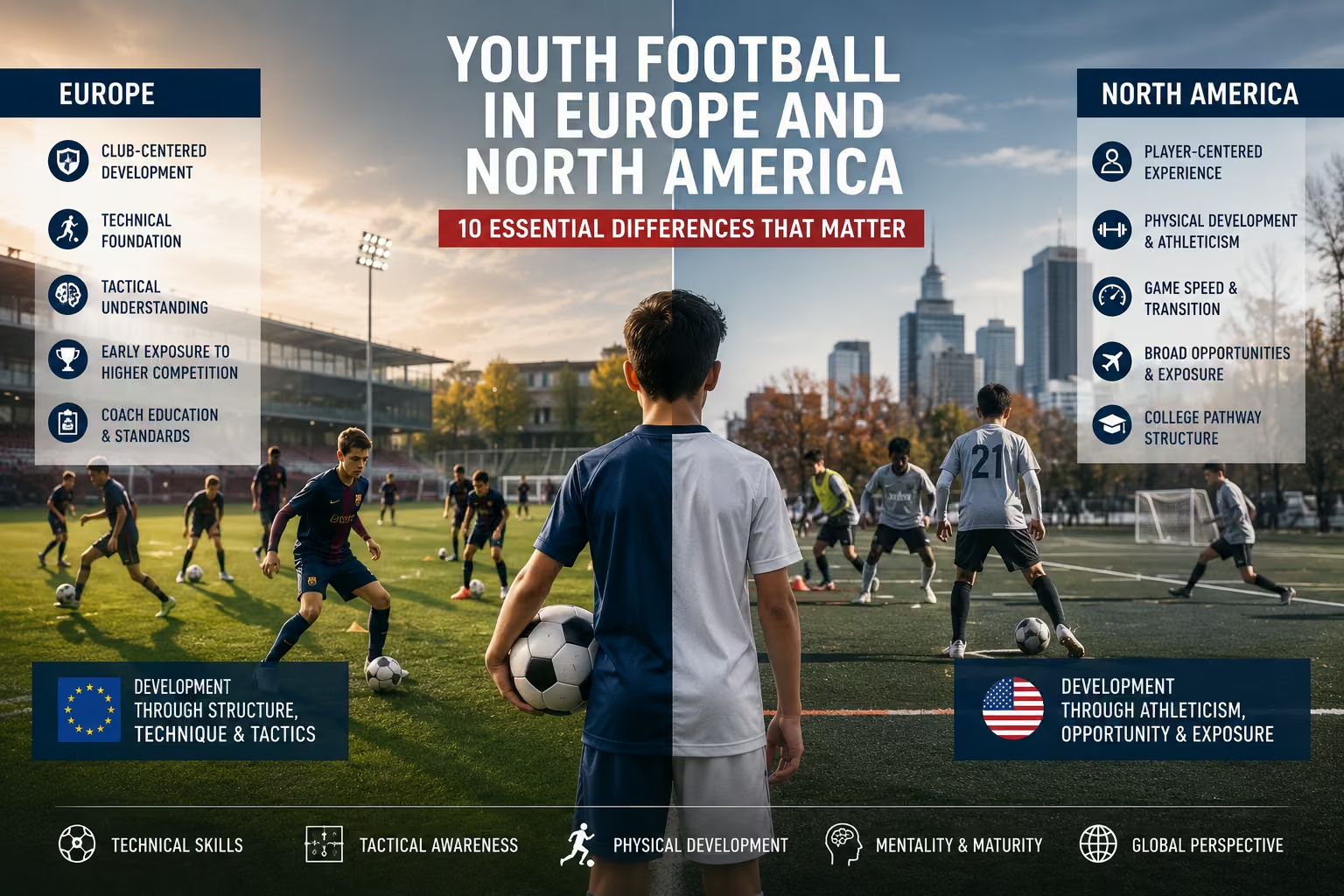
Youth football in Europe and North America is shaped by different cultures, club structures, coaching systems, competition models, and pathway expectations. For players, parents, coaches, and academy directors, understanding those differences matters because development is not only about talent. It is also about environment.
A player can train hard in Canada or the United States and still benefit from seeing how the game is taught, played, and lived in Spain, England, Italy, Austria, or another European football country. At the same time, North America has strengths that should not be dismissed. Facilities, education links, athletic development, parental involvement, and growing professional pathways can all support player growth.
The real question is not whether Europe or North America is automatically better. The better question is what each environment teaches, where each environment can fall short, and how players can use international football experiences to become more complete.
Match Tour 11 helps players, teams, academies, clubs, and school football programs access professional football environments across North America and Europe through international football tours, training camps, tournaments, trials, evaluations, player management, and professional signing support.
Why This Comparison Matters for Players and Parents
The difference between youth football in Europe and North America matters because players are often evaluated by the environments they have experienced. A player who only knows one system may have a limited view of the game. They may know how to succeed locally but struggle when the football problem changes.
European football often exposes players to deeper club cultures, more integrated professional pathways, stronger daily football identity, and different tactical expectations. North American football often gives players access to organized leagues, education-based pathways, strong facilities in many regions, and increasing professional opportunities through domestic clubs and academies.
Neither environment is perfect. Europe can be highly competitive, selective, and demanding. North America can be fragmented, expensive, and uneven depending on region, club, coaching quality, and competition level.
For Canadian and North American players, the most useful approach is to learn from both. Players should build strong habits at home, then use international experiences to test those habits against different standards.
1. Football Culture Is More Embedded in Daily Life in Europe
One of the clearest differences is culture. In many European countries, football is deeply embedded in daily life. Clubs are connected to towns, neighbourhoods, families, local identity, and long histories. Young players grow up surrounded by football conversation, match-day culture, and clear examples of professional pathways.
In North America, football has grown significantly, but it still competes with many other sports for attention, facilities, media coverage, and athlete participation. In Canada and the United States, players may split time between football, school sport, hockey, basketball, baseball, athletics, or other activities.
This cultural difference affects player development. In Europe, players often learn the game through immersion. They watch more football, discuss more football, play more informal football, and understand club identity earlier. In North America, players may need more deliberate exposure to match analysis, professional environments, and football culture.
This is one reason international football tours can be valuable. When a player travels to Spain, England, Italy, or Austria, they experience football as part of the daily environment, not only as an activity scheduled after school.
2. European Clubs Often Connect Youth Development to Professional Structures
European youth football is often connected more directly to professional club structures. Many clubs operate academy systems where young players train within the same broader institution as the professional team. The pathway is not always easy, but the structure is visible.
A young player in Europe may understand early that academy football is linked to club identity, professional standards, and competition for future opportunities. This can create sharper daily pressure and clearer expectations.
In North America, the pathway has historically been more fragmented. Players may move through community clubs, private academies, school programs, provincial or state systems, college pathways, MLS academies, Canadian Premier League environments, USL clubs, or independent training providers. The growth is real, but the pathway can be harder for families to interpret.
For players and parents, this means clarity is essential. A player should know whether they are in a development environment, a competitive academy, a showcase model, a college pathway, or a professional evaluation process. Each serves a different purpose.
3. Coaching Education Is Structured Differently
Coaching quality is one of the most important factors in player development. Europe has long-established coach education structures through national associations and UEFA licensing pathways. UEFA’s coach education system emphasizes technical excellence, realistic coaching practice, and clear educational pathways for coaches.
North America also has formal coaching pathways through Canada Soccer and U.S. Soccer, and these systems continue to develop. Canada Soccer’s Long-Term Player Development approach emphasizes age-appropriate training, competition, and coaching based on player needs.
The practical difference for families is that coaching quality varies everywhere. A European environment is not automatically good because it is European. A North American environment is not automatically weaker because it is local. The real question is whether the coach teaches the game clearly, connects training to match problems, gives useful feedback, and understands the player’s development stage.
Players should seek environments where coaching is specific, demanding, and connected to the game. That standard matters more than geography alone.
4. Technical Development Is Often Pressured Earlier in Europe
In many European football environments, technical speed is tested early. Players are expected to receive under pressure, scan before receiving, pass with the correct weight, play in tight spaces, and make decisions quickly.
This does not mean North American players lack technique. Many are technically strong. The difference is often the pressure attached to technique. A player may have clean ball skills in training but need to prove those skills against opponents who close space faster and punish slow decisions.
European environments can expose small details quickly. A poor first touch may remove the next passing option. A late scan may cause a turnover. A player who dribbles when the pass is available may slow the team’s rhythm.
For North American players, this can be a major lesson. Technical ability is not only about performing skills. It is about using technique to solve football problems under pressure.
5. Tactical Learning Can Be More Club-Specific in Europe
European youth players are often exposed early to tactical concepts connected to club identity. This may include pressing principles, positional play, defensive compactness, transition behaviour, build-up patterns, or specific roles within the team structure.
In North America, tactical development can vary widely. Some academies are highly structured. Others rely more on athleticism, individual ability, tournament results, or general team organization. The gap is not universal, but inconsistency is common.
Tactical learning matters because players must understand the game beyond their own actions. A winger needs to understand pressing triggers. A fullback needs to know when to overlap or protect transition. A midfielder needs to scan, support, and manage tempo. A centre-back needs to control space, communicate, and build play.
International exposure helps players experience different tactical problems. They may face teams that press differently, defend more compactly, or move the ball faster. This forces players to think, not only react.
6. Competition Structures Create Different Pressures
Competition looks different across Europe and North America. In Europe, youth players may be connected to club leagues, academy competitions, promotion and relegation cultures, and environments where football identity is strongly tied to results and development.
In North America, competition can include local leagues, regional leagues, private academy circuits, school competitions, showcase events, tournaments, college recruitment settings, MLS academy platforms, CPL-related environments, and other pathways. This variety can create opportunity, but it can also create confusion.
One common North American issue is the overuse of tournaments and showcases without enough connection to long-term development. Players may be seen often but not always developed properly. Exposure without readiness is limited.
A good competition structure should challenge players at the right level. Too easy, and players develop bad habits. Too difficult, and players may become overwhelmed. The goal is useful pressure.
7. The Role of Education Is Different
Education plays a different role in North American football. In Canada and the United States, families often connect sport with school, college, scholarships, and academic planning. This can be a strength. It gives players options and can protect them from putting everything into one uncertain pathway.
In Europe, professional club pathways can become more football-specific earlier. Players may enter academy environments where football is central to daily life, and education is coordinated around that structure. This can accelerate football development for selected players but can also be highly competitive and selective.
For North American players, the challenge is balancing ambition with practical planning. Europe may be a goal, but school, domestic competition, physical development, and mental maturity still matter.
A credible pathway does not force every player into one route. Some players may pursue college football. Some may aim for domestic professional environments. Some may seek European trials when ready. Some may use international tours or camps to benchmark their development before making bigger decisions.
8. Player Evaluation Is Often More Ruthless in Professional European Settings
Professional European environments can be direct in how they evaluate players. Coaches and clubs may assess quickly whether a player fits the level, position, physical profile, tactical model, and squad need.
For North American players, this can feel different. Some players are used to more encouragement, more explanation, or more parent-facing communication. In a professional setting, feedback may be shorter, sharper, and more performance-based.
This is not necessarily negative. It can help players understand the standard more clearly. A player learns that effort matters, but performance, decision-making, adaptation, and role execution matter too.
Match Tour 11’s player trials and evaluations are built around this reality. Suitable players can enter professional club environments across Europe, train inside daily football settings, receive evaluation from professional staff, and leave with honest feedback.
A trial should never be treated as a guaranteed signing. It is an assessment. The value is clarity.
9. North America Can Offer Strong Athletic and Personal Development
North America also has real strengths. Many players benefit from strong athletic development, multi-sport backgrounds, school support, family involvement, facilities, strength and conditioning access, and an increasingly professional domestic football landscape.
Multi-sport participation can help younger athletes build coordination, speed, resilience, and general athleticism. Education-based pathways can give players more time to mature. Domestic professional growth has also made the player pathway more visible than it was in previous generations.
The issue is not that North America lacks development value. The issue is that players need the right football specificity at the right time. Athleticism alone is not enough. Strong facilities alone are not enough. Exposure alone is not enough.
Players need technical detail, tactical intelligence, competitive pressure, feedback, and environments that match their current level. When North American strengths are combined with European benchmarks, players can develop a more complete profile.
10. International Exposure Helps Players Connect Both Systems
The best players learn from different environments. A Canadian or North American player can build strong habits at home, then use European experiences to test and refine those habits.
International football exposure can happen through several routes. A team may travel through international football tours. A player may attend training camps. A team may compete in international tournaments. An advanced player may pursue an individual trial or evaluation. A professional-ready player may need player management and professional signings.
Each route serves a different purpose. A tour exposes players to new environments. A camp improves training habits. A tournament tests competition. A trial evaluates readiness. Player management supports professional opportunities.
This is where Match Tour 11’s pathway model becomes useful. The company does not need every player to take the same step. The correct opportunity depends on age, level, position, maturity, video, passport status, team goals, and development objectives.
What European Youth Football Often Teaches Best
European youth football often teaches players how deeply the game is connected to club culture, daily standards, tactical detail, and professional expectations.
Players may learn to make decisions faster, receive under pressure, respect positional roles, handle direct feedback, and understand the emotional pressure of representing a club community.
European environments can also teach players humility. There are many talented players. The difference often comes from consistency, game intelligence, coachability, and professional habits.
For North American players, this can be valuable because it creates a clearer benchmark. A player may return home with a better understanding of what must improve and how daily training needs to change.
What North American Youth Football Often Teaches Best
North American youth football can teach players organization, athletic development, educational balance, resilience across travel-heavy schedules, and the ability to manage multiple responsibilities.
Many players in Canada and the United States learn to balance school, club, training, family expectations, travel, and competition. This can build maturity when managed properly.
North America also gives players several possible routes. A player may pursue domestic academies, college football, professional opportunities in Canada or the United States, or international pathways when appropriate.
The challenge is making those routes clearer. Families need to understand what each pathway can and cannot provide. A showcase is not a trial. A camp is not a contract pathway. A tour is not a guaranteed scouting event. Good pathway planning separates these stages.
Why Canadian Players Should Understand Both Systems
Canadian players sit in a useful but complex position. Canada is developing stronger domestic football structures, but many ambitious players still look toward Europe as a benchmark or pathway option.
Understanding both systems helps players make smarter decisions. A player does not need to reject North America to learn from Europe. They can develop at home while using European environments to test themselves.
A young player may start with a Manchester City Football School camp in Canada through Match Tour 11’s City Football Group partnership. A team may later travel to Spain, England, Italy, or Austria for a development-focused tour. An advanced player may build a profile and seek a structured evaluation when ready.
This staged approach is more realistic than chasing Europe immediately. It gives players time to develop, gather evidence, and understand what the next step requires.
How Coaches Can Use This Comparison in Player Development
Coaches can use the comparison between youth football in Europe and North America to improve their own environments. The goal is not to copy Europe blindly. The goal is to identify useful principles.
Practical coaching takeaways
- Connect every training session to real match problems.
- Teach scanning, body shape, and decision-making early.
- Use small-sided games to increase touches and decisions.
- Demand technical execution under pressure, not only in isolation.
- Build tactical understanding by position and game phase.
- Give direct but age-appropriate feedback.
- Help players understand the difference between exposure and readiness.
- Use international benchmarks to inform development plans.
Academies that apply these principles can improve player development without waiting for players to leave the country.
How Parents Should Evaluate Development Environments
Parents should evaluate development environments based on coaching quality, competition level, feedback, player care, pathway honesty, and long-term fit.
Useful questions include:
- Does the coach teach the game clearly?
- Is the player challenged at the right level?
- Does training connect to match situations?
- Does the player receive specific feedback?
- Is the environment focused on development or only results?
- Are pathway claims realistic?
- Does the player have access to strong match footage?
- Would international exposure help benchmark the player?
Parents should avoid simplistic thinking. Europe is not automatically better. North America is not automatically weaker. The correct environment is the one that helps the player grow at the right stage.
How Match Tour 11 Helps Bridge the Development Gap
Match Tour 11 helps bridge the development gap between youth football in Europe and North America by giving players and teams access to credible football environments abroad while keeping pathway expectations realistic.
For teams, Match Tour 11 organizes end-to-end football tours in Europe. These tours may include professional training at club facilities, competitive matches, stadium experiences, live professional football, cultural activities, accommodation, meals, ground transportation, and full tour coordination.
For players, Match Tour 11 supports training camps, player trials, evaluations, player management, and professional signing support where appropriate. The company has supported players and teams across North America and Europe and works with professional club environments in Spain, Italy, Austria, and England.
The purpose is not to tell every player to leave North America. The purpose is to help players understand the international standard and choose the right next step.
Useful Football Development Resources
Players, parents, and coaches can use credible resources to understand player development more clearly. The FIFA Training Centre provides global player and coach development content. UEFA offers resources on coach development, coaching courses, and grassroots football programmes. Canadian families can also review the Canada Soccer ecosystem to understand the domestic player development structure.
These resources help families and coaches frame the comparison properly. The goal is not to choose a side. The goal is to understand what players need at each stage.
Common Questions About Youth Football in Europe and North America
Is youth football better in Europe than North America?
Not automatically. Europe often offers stronger football culture, deeper professional club pathways, and more tactical immersion. North America can offer strong athletic development, education pathways, facilities, and growing professional opportunities. The right environment depends on the player.
Why do North American players travel to Europe for football?
Players travel to Europe to experience different coaching styles, faster decision-making, professional club environments, stronger tactical demands, and international competition. The goal should be development and benchmarking, not guaranteed outcomes.
Can Canadian players develop well without going to Europe?
Yes. Canadian players can develop well at home with strong coaching, competition, habits, and feedback. Europe can add a valuable benchmark when the player is ready for international exposure.
When should a player consider a European trial?
A player should consider a European trial only when they have strong match footage, a clear player profile, serious competitive experience, maturity, and a realistic club fit. Many players need camps or tours before trials make sense.
How can teams experience European football safely and realistically?
Teams can use structured international football tours that include appropriate training, competitive matches, supervised travel, accommodation, meals, transport, and clear development objectives.
Final Thoughts on Why the Difference Matters
The difference between youth football in Europe and North America matters because players are shaped by their environment. Culture, coaching, competition, pathways, pressure, and feedback all influence how a player develops.
Europe can teach players about football immersion, tactical detail, professional club culture, and faster decision-making. North America can support athletic development, education balance, and increasingly credible domestic pathways. The strongest player development approach learns from both.
For Canadian and North American players, international exposure can be valuable when used at the right time. It can show players where they stand, what they need to improve, and how the game is taught in different environments.
Match Tour 11 supports that process through football tours, training camps, tournaments, trials, evaluations, and player management services designed to connect players and teams with professional football environments while keeping expectations realistic.
To discuss the right international development step for a player, team, academy, school program, or club, contact Match Tour 11 with the age group, current level, preferred destination, travel window, and football objectives.